Regulatory reform means different things to different people. Its most basic goals are to eliminate excessive and unreasonable regulations(1) while at the same time, make regulatory policy more efficient, accessible and open to the public. Often overlooked in this campaign to weed out needless regulations is the process which produced the regulations in the first place. This process is commonly known as rulemaking.
The role of rulemaking in establishing government policy cannot be understated, because it
is difficult to delineate precisely where legislative lawmaking ends and administrative rulemaking
begins. U.S. Supreme Court Justice Byron White has explained that: "(t)here is no question but that
agency rulemaking is lawmaking . . . ."(2) Thus, while the District's Home Rule Charter requires action
by the Council, the Mayor, the Financial Authority(3), and Congress to enact a law, an administrative
agency can often accomplish the same thing by simply publishing a notice twice in the D.C. Register.
This paper briefly examines the procedures used to formulate the District of Columbia's
administrative rules and regulations; compares the differences between federal, state and municipal
rulemaking procedures; and discusses whether the District might benefit from the adoption of modern
administrative rulemaking procedures. It further offers recommendations designed to improve the
District's overall regulatory policies. The premise of this paper is that the process used to adopt the
District's regulations affects the quality of its regulations, and that if regulatory reform does not
include improvements in the process of rule formulation, the quality of regulations will not improve.
I. INTRODUCTION
The substantive provisions of District of Columbia law governing rulemaking have not been
reexamined in nearly three decades.(4) In fact, there is very little practical difference between the
current rulemaking provisions and those enacted in 1887 providing that no regulation could be
enforced until 30 days after publication.(5) D.C. rulemaking procedures have remained unchanged
despite the fact that many other jurisdictions have since that time, revised their statutes for the
purpose of relieving citizens of unnecessarily burdensome regulations, ensuring that regulations are
adopted only to achieve a specific legislative purpose, and that there exists a public need to adopt
the regulations.
The District of Columbia Revitalization and Self-Government Improvement Act of 1997,(6)
requires the District of Columbia Financial Responsibility and Management Assistance Authority
(Authority) to review and analyze existing D.C. regulations which unnecessarily and inappropriately
impair economic development, and the financial stability and management efficiency of the D.C.
government. The Authority is to make specific findings and conclusions with respect to
recommendations of the Business Regulatory Reform Commission(7). The Authority is then to take
appropriate action to repeal or revise the regulations of the District of Columbia.
The Business and Regulatory Reform Commission report contains several recommendations
concerning rulemaking procedures, they are:
These recommendations are discussed in various parts of this paper. The reference to "statutes" in
recommendation number 3 above should probably be a reference to "regulations" because all Council
acts and resolutions are currently required to contain fiscal impact statements.(9)
II. THE DISTRICT'S EXISTING RULEMAKING PROCEDURES
Rulemaking in the District of Columbia is governed by the D.C. Administrative Procedure Act(10) (D.C. APA) and the District of Columbia Documents Act(11) which were adopted in 1968 and 1979 respectively. The D.C. APA was the first statute to require that regulations be published in the D.C. Register, although in practice District rules and regulations have been published in the Register since 1954 in accordance with an order of the Board of Commissioners.(12)
District rulemaking has been decreasing - In the past 10 years, D.C. administrative agencies
have issued more than six thousand (6,000) emergency, proposed or final rules. Despite a popular
belief to the contrary, the number of regulations issued by District administrative agencies during this
period has substantially declined.
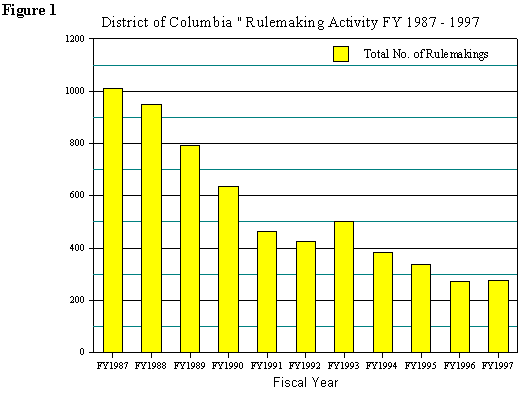
The decline in the number of rulemakings in recent years suggests that much of the problem with burdensome regulations concerns existing regulations to a much greater extent than new regulations. Thus any discussion of the problems and recommended solutions must specifically" target existing regulations while putting in place procedures to prevent the promulgation of undesirable new regulations. The preceding chart (Figure 1) details the trend in rulemaking volume over the last ten years. In terms of numbers of rules issued, emergency rulemaking is the only category that has remained constant over the ten year period. The bulk of these emergency rules consists of traffic signs, rules needed to comply with federal law to prevent a loss of funding, and rules issued in response to emergency legislation enacted by the Council. Thus, many of these rules are not discretionary.
A Simplified scheme is in use - The District's system of rulemaking is a simplified or
"streamlined" model which does not require a basis and purpose statement, economic impact analysis
or any consistent form of executive or legislative policy review. The process generally requires little
more than publication of a Notice of Proposed Rulemaking followed 30 days later by a Notice of
Final Rulemaking. There are a number of exceptions to this procedure. These exceptions which are
contained in the specific substantive statutes authorizing the promulgation of rules are discussed in
greater detail later in this paper; however, statutes requiring a public hearing or Council review of
rules are the exception and not the rule. Many District agency personnel have a difficult time
complying with our current "simplified" rulemaking procedures. A flowchart of this process is set
forth in Figure 2 on page 5. The following section discusses a number of modern rulemaking
procedures which have been adopted by states and municipalities, and compares those to the
District's procedures.
 III. Modern Administrative Procedure Reforms
There are essentially 3 models upon which states base their administrative procedures. These are the 1947 federal Administrative Procedure Act(13), (1947 APA) the 1961 Uniform Law Commissioners' Model State Administrative Procedure Act(14), (1961 MSAPA) and the 1981 Uniform Law Commissioners' Model State Administrative Procedure Act(15) (1981 MSAPA). These model acts differ in a number of respects; however, it is fair to say that the later acts are much more detailed than each of the earlier counterparts. In addition to the model statutes, there are provisions from other jurisdictions which might prove helpful to the District in its rule formulation policy. The reforms discussed include administrative waivers or variances, executive and legislative review of rules, basis and purpose or regulatory analysis statements, and other recently adopted policies.
A. Administrative Waivers or Variances
The use of administrative waivers or variances to relieve the public from unduly harsh regulations exists in numerous places in both District laws and regulations. While the D.C. Code contains nearly a dozen provisions authorizing variances(16), there are more than 100 regulatory provisions in the DCMR authorizing the waiver of regulatory requirements.(17) The most commonly known and widely used variance procedure is in the zoning context where relief from "undue hardship" or "practical difficulties" created by the application of zoning regulations has been permitted since at least 1938.(18) Other provisions range from authorization to waive procedural requirements or fees, to provisions authorizing the waiver of "...any provisions of these rules."(19)
At least one state permits administrative waivers in its Administrative Procedure Act, although several states provide parties with an opportunity to request a hearing relating to a request for, or denial of a variance request.(20) The state of Florida has one of the most widely publicized modern statutes which includes, among other provisions, a process authorizing waivers or variances from the application of administrative regulations. The statute allows agencies to vary the requirements of their rules so long as the purpose of the underlying statute can be achieved and application of the rule would create a substantial hardship or violate the principles of fairness.(21) All requests for a waiver or variance must by published in the equivalent of the D.C. Register.
A variance allows an agency to alter the requirements of its rules, while a waiver is a decision
permitting the agency to not apply its rules at all. The adoption of a uniform administrative waiver
policy would appear to be an excellent interim measure to be applied in the District of Columbia,
because it would require agencies to balance the need for enforcement of its regulations against the
burden imposed on the public. This approach also has the advantage of permitting agencies to phase
out outdated, unnecessary, duplicative, and burdensome regulations as they are identified or whenever
the need arises. In other words, the frequent use of waivers or variances could indicate a need to
review and update a particular rule.
B. Formal Review of Administrative Rules
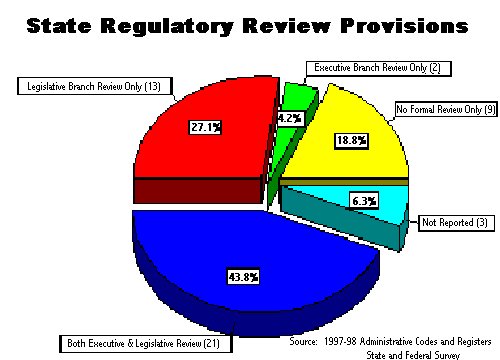
Most states have adopted laws requiring legislative or executive branch review of regulations prior to their effectiveness. Figure 3 above reflects that 75% of the states require some type of formal review of regulations. This approach only affects new regulations and unlike the waiver would not be effective at relieving existing "anti-competitive" or burdensome regulations.
Jurisdictions differ as to which elements must be included in rules that are subject to review. These elements may include economic impact statements, statutory authority justifications, consideration of lower cost regulatory alternatives, or even rulemaking records. It is important to note that the Financial Authority obtained authorization from Congress to review District rules and regulations "...in the same manner as a contract or lease."(22) Contracts or leases reviewed by the Financial Authority must, among other requirements, contain a certification that they are consistent with the financial plan and budget.(23)
The District's Rulemaking Review Policies - Only certain rulemakings in the District are required to be reviewed by the Council. The Council has identified at least 25 different statutes which require Council review of rules proposed by the Mayor or other executive agencies.(24) There is no clear pattern as to the types of rules which must be reviewed. For example, all procurement rules must be submitted to the Council whereas only certain personnel, construction related, and motor vehicle rules are subject to review by the Council. In some instances, an agency may choose to issue the same type of rule under a different provision of law, thus effectively determining whether or not the rule will be subject to review by the Council.(25) For rules which are subject to Council review, there is no uniform statutory procedure governing their submission; however, in practice all rules subject to Council review are submitted using the same procedure.(26)
The Council can act without express authority - The Council has on occasion exercised its legislative prerogative to overturn or prevent an administrative rule from becoming effective, although it had no expressly reserved right of review. Two instances which come to mind include a Council action to prohibit the Department of Housing and Community Development from suspending the taking of applications for public housing and a Council act to override an order of the Wage Hour Board increasing the minimum wage for certain classes of workers.(27)
Surrounding Jurisdictions all Require Formal Review of Rules - The states of Maryland, Virginia and the federal government all require some form of executive or legislative review. Maryland enacted the "Regulatory Review and Evaluation Act" in 1985.(28) The purpose of the Maryland statute is to determine whether regulations continue to be necessary for the public interest; continue to be supported by statutory authority and judicial opinions; are obsolete or otherwise appropriate for amendment or repeal; and whether they assist the Executive Branch in being accountable and responsive to the public interest. The Maryland statute contains provisions for both executive and legislative review.(29) The Virginia rulemaking statute provides for review by both the governor and any branch of the General Assembly.(30) The Virginia statute requires an impact analysis and basis and purpose statement prior to their becoming effective. The federal government has a very extensive system of executive branch regulatory review, including review by the Office of Management and Budget, and the Office of Information and Regulatory Analysis.(31)
Legislative Review Requirements have generally been upheld by Courts - Legislative review provisions have been invalidated on a number of occasions, generally based on a separation of powers argument. Most of the statutes which were invalidated involved either a one house veto, a legislative committee veto, or another process in which the legislature "vetoed" administrative rules without resorting to the formal legislative process.(32) Other courts have upheld legislative vetoes of administrative rules as long as the procedures are consistent with the state constitution.(33) There are only a limited number of methods a legislature can use to review rules: 1)the rule is voided or approved if one or both houses act, 2) the rule is voided or approved if a joint committee acts, or 3) the rule is voided or approved after action by both houses and the governor.(34) Unless permitted by the state's constitution, methods 1 and 2 have been most often subject to challenge. The most common arrange involves the legislature suspending the effectiveness of administrative rules pending formal action by the legislature.
The unique nature of the District government renders a successful challenge unlikely because virtually all agency rulemaking authority has been delegated from the Council.(35) Because the Council already reviews so many administrative rules based on the individual substantive statutes, it is not reasonable to believe that the Council could not do in a statute of general applicability the same thing it is now doing in individual statutes. The charter independent agencies may present problems if the Home Rule Act has vested rulemaking authority in those agencies.(36)
Review ensures public will prevails - Review of rules by the legislature or chief executive ensures that the popular will prevails over the preferences of unelected administrative officials. It is also designed to provide coordination of policy between numerous unrelated agencies. In state legislatures, review of rules has been viewed as a means for legislators to retain a measure of control over the implementation of their laws, and reassert authority as the ultimate policy making branch of government.(37) Criticism of legislative review procedures may be viewed as micromanagement, the interjection of politics into scientific and technical areas, or a violation of separation of powers. The Business Regulatory Reform Commission recommended that the position of Assistant Administrator for Regulatory Reform be established in the City Administrator's office for coordination of policy and to conduct cost benefit studies.(38)
C. Basis and Purpose or Regulatory Analysis Statement
A basis and purpose statement is designed to explain the proposed rules to the public, and assist a reviewing court in determining whether the regulations have a sufficient legal basis. Although both the current federal and both of the latest model APA's contain a basis and purpose statement requirement, the District's rulemaking procedures do not require that any explanation or rationale for the adoption of a rule be published with a notice of proposed rulemaking.(39) Both Maryland, Virginia, and two of the three model acts require either a basis and purpose statement or a fiscal analysis, as follows:
Maryland - The statement shall contain an estimated economic impact, and a public hearing notice.
Virginia - Agency must publish a summary, basis, purpose, substance, issues and economic impact of the
regulations.
1947 APA - The notice must include reference to the authority under which the rule is proposed, and either the
substance of the proposed rule or a description of the subjects and issues involved.
1961 MSAPA - The notice shall include a statement of either the terms or substance of the intended action or a
description of the subjects and issues involved; and if requested a concise statement of the principal
reasons for and against the rule, incorporating its reasons for overruling the considerations urged
against adoption of the rule.
1981 MSAPA - The notice must include a short explanation of the purpose of the rule, the specific legal authority
authorizing the rule, how persons may demand an oral proceeding on the rule, and upon request
a regulatory analysis of the rule including a description of the classes of persons affected, the
probable cost, cost/benefit analysis, less intrusive alternatives, among other items.
D.C. APA - The notice must "afford interested persons opportunity to submit data and views either orally or in
writing, as may be specified in such notice."
The District's statute actually has no specific content requirement for the notice. The only content requirement is found in the rules of the Office of Documents which state that the notice shall contain "a brief description or title of the proposed rule."(40) Thus by way of comparison, the District's statute requires less than the 1947 APA.
Each succeeding version of the model statutes have added new requirements which are triggered by a request from affected persons. This is a method of gradually introduced additional requirements. It would be prudent for a municipality to adopt language that not permit the content of a basis and purpose statement from being used to invalidate an adopted rule.
D. Re-enactment or Sunset Provisions
There are states which require that all regulations be positively re-enacted at periodic intervals.(41) This requires agencies to regularly reexamine their regulations. However at some point the re-enactment could easily become a perfunctory exercise. The other approach is that all regulations would sunset or cease to be legally effective if they are not adopted or re-enacted by a certain date. This was the approach taken in the District of Columbia when the Documents Act was originally enacted.(42) This provision proved troublesome at the time and required several extensions of the statutory deadline.(43) The Virginia Administrative Procedure Act provides for a periodic review of existing regulations for the purpose of determining whether the regulations are necessary for the protection of the public health, safety and welfare, and whether the regulations are clearly written and easily understandable.(44) The governor of Maryland, pursuant to its Regulatory Review and Evaluation Act, issued an executive order in 1986 requiring review of "... all agency rules within five years, and during each five-year period thereafter."(45)
E. Prohibition on Incorporation by Reference
The District of Columbia Documents Act generally does not permit agencies to incorporate federal regulations into the D.C. Municipal Regulations by reference to the federal regulations. (46) This results in needless duplication of regulations and added personnel expense. When a federal rule is changed, the District is required to begin the labor intensive task of amending its rules to reflect the federal changes. This does not apply to federal rules with which the District is required to comply however, it does apply to the many federal rules which although discretionary, are tied to the receipt of federal dollars. The 1981 Model State Administrative Procedure Act (1997 -98 ed.) permits the incorporation by reference of federal or state rules.(47) The States of Maryland(48), Virginia(49), and the federal government(50) all permit more documents to be incorporated into their administrative codes than the District of Columbia. The Financial Authority in its report "Toward a More Equitable Relationship: Structuring the District of Columbia's State Functions," recommended that the District "... be a leader in fostering compliance with federal regulations that either encourage or demand state level uniformity. One simple way to do this is to facilitate the process of incorporating federal regulations into the DCMR by reference.
District of Columbia - The types of documents which can be incorporated by reference into the District of Columbia Municipal Regulations are limited to unusually lengthy documents which are not ' rules, regulations, or documents having general applicability and legal effect.'(51) On its face, this provision prohibits incorporation by reference of federal regulations.
Maryland - In the state of Maryland, documents may be incorporated where the documents "have been declared documents generally available to the public and appropriate for incorporation by reference." Beginning in 1996, Maryland specifically authorized the incorporation by reference of provisions from the following documents: i) the Annotated Code of Maryland, ii) Session Laws, iii) the U.S. Code, iv) U.S. Statutes at Large, v) Code of Federal Regulations, vi) Federal Register, and vii) any other generally available publication that the Administrator specifies.(52)
Virginia - In Virginia, agencies are specifically authorized to incorporate by reference provisions from the Code of Federal Regulations and the Federal Register. Other documents may be incorporated by reference if they are made available to for public copying and inspection.(53)
Federal government - The federal government permits documents to be incorporated by reference if they are, among other items, i) published data, criteria, standards, specifications, techniques, illustrations or similar materials and ii) reasonably available to the public.(54)
F. Other Modern Administrative Reforms
There are a number of additional popular administrative reforms, including the establishment of a central administrative hearing office; a requirement that agencies publish or index agency decisions; provisions related to electronic communications including FOIA or telephone hearings; and the establishment of uniform agency procedures.
Central Administrative Hearing Agency - The D.C. Municipal Regulations are replete with a series of different hearing procedures for a multiplicity of agencies, laws and regulations. The DCMR contains entries for more than seventy-five (75) separate and distinct agency hearing procedures(55). A proposal to establish a central administrative hearing agency for the District of Columbia government has been introduced at least twice in the Council but has not yet been adopted.(56) Permitting telephone hearings for certain proceedings has also proven to be cost effective in several jurisdictions.
Uniform Rules of Agency Procedure - One alternative to the establishment of a centralized hearing office is the establishment of uniform rules of procedure which are applicable to all agencies. A stated purpose given for adopting the D.C. Administrative Procedure Act in 1968 was to "prescribe uniform administrative procedures for the more than 93 administrative agencies in the D.C. government."(57) The city of Jacksonville by ordinance provides that the Mayor "shall promulgate one or more sets of model rules of procedure ... which shall be the rules of procedure for each agency..."(58) The D.C. Administrative Procedure Act provides that the Mayor shall ...establish or require each subordinate agency to establish procedures in accordance with the APA.(59) The next logical step would be to ensure that the agency procedures are as consistent as practicable.
Indexing of Agency Orders - In addition to rulemaking, an agency can make "laws" by
interpreting its implementing statute on a case by case basis through the issuance of agency orders.
These interpretations are often binding precedent; however they are generally unavailable or
inaccessible to the public. As a result of this, several jurisdictions have imposed upon agencies the
requirement that the agencies publish or at a minimum index their decisions. Examples of District
agencies which are required to publish their decisions include the Contract Appeals Board(60), the
Office of Employee Appeals(61), the Public Employee Relations Board(62), the Zoning Commission and
the Board of Zoning Adjustment.(63) Examples of bodies which are not required to publish their
decisions include the Rental Housing Commission, the Office of Adjudication (DCRA), the Alcoholic
Beverage Control Board, Historic Preservation Review Board, and the Board of Appeals and Review.
IV. Comparison of State and Municipal Rulemaking Procedures
State administrative agencies derive their rulemaking authority from the legislature pursuant to the state constitution.(64) All municipalities possess rulemaking authority by delegation from a superior legislative body by charter, statute or ordinance.(65) The Council of the District of Columbia's legislative authority was derived by delegation from the Congress of the United States pursuant to Article I, Section 8 of the United States Constitution. The Council has in turn decided to delegate some its "legislative" authority to administrative agencies in the form of rulemaking.(66) Because the typical city has less authority and operates within the limitations permitted by its sponsoring state, state administrative rulemaking procedures are generally much more detailed than those of municipalities. Municipal rulemaking procedures are varied, and depend upon the form of government and scope of authority delegated by the state or county.
One of the objections to the imposition of modern administrative reforms concerns the reality that the District is not a state and therefore does not have the resources of a state that would enable it to administer a detailed regulatory program for mundane city functions.(67) At the time of adoption of the D.C. Administrative Procedure Act in 1968, District officials stated that "no other city has had an administrative procedure act imposed on its procedures, and that only a minority of the States have such an act ..."(68)
Since that time, we now know that most states and a number of other cities have adopted some, but not all, of the modern administrative procedures discussed, including requirements for basis and purpose statements, and consideration of economic impact of regulations. Even proponents of modern administrative reforms recognize the burden that would be placed upon municipality if all of the formal procedures used by states were applied to municipalities. Although it is generally thought to be impracticable, a simplified procedural code, it is thought, would "serve the public interest and ... provide a uniform method of judicial review."(69)
The District, while it is a city, exercises state functions in a number of areas. In 1968, officials of the District government estimated that 22 percent of all functions performed by the District are "in the nature of ... State functions."(70) The D.C. Financial Responsibility and Management Assistance Authority in its report issued on April 15, 1997, concluded that state type regulations included "utility rate approval, alcohol and tobacco, securities brokerage and licensing, motor vehicle licenses and permits, and environmental protection."(71)
The Financial Authority, in its Toward a More Equitable Relationship: Structuring the
District of Columbia's State Functions (Report on State Functions), surveyed eight "selected cities"(72)
to examine and compare how "state-related" public services are related. The Authority concluded
that the District and federal government should work together in the development of "state-type"
regulations, and that the District should continue to have control over mixed and predominately local
regulatory functions. Of the cities surveyed by the Authority, many do not require a basis and purpose
statement, an economic impact statement or consideration of less costly regulatory alternatives. It must be noted however, that for most of these cities, the legislative branch adopts the majority of
"rules and regulations" by ordinance. Because ordinances are legislative actions, the need for additional protections may not be as important as they are with administrative rulemaking. A
summary of the rulemaking procedures used by adjoining states and surveyed cities is set in Tables
1 and 2.
 Other examples of insignificant rules include minor modifications of existing rules, and the
adoption of federal rules and standards. These rules should not be subjected to the "double" review
process whereby rules are reviewed at both the proposed and final stage. They would be good
candidates for the direct final rulemaking procedure, whereby rules are published only once unless
comments are received. If no comments are received, the rules become effective without further
action. Currently the Office of Corporation Counsel reviews rules a second time only if the agency
receives comments challenging the legal sufficiency of rules or make substantial changes between the
proposed and final rulemaking. The Business and Regulatory Reform Commission also identified
the "double" review process as wasteful of scarce resources.
Other examples of insignificant rules include minor modifications of existing rules, and the
adoption of federal rules and standards. These rules should not be subjected to the "double" review
process whereby rules are reviewed at both the proposed and final stage. They would be good
candidates for the direct final rulemaking procedure, whereby rules are published only once unless
comments are received. If no comments are received, the rules become effective without further
action. Currently the Office of Corporation Counsel reviews rules a second time only if the agency
receives comments challenging the legal sufficiency of rules or make substantial changes between the
proposed and final rulemaking. The Business and Regulatory Reform Commission also identified
the "double" review process as wasteful of scarce resources.